
Construction Loans for Duplexes and Dual Occupancy Builds
ADS Team
Author
November 16, 2026
about 2 hours ago
2
views
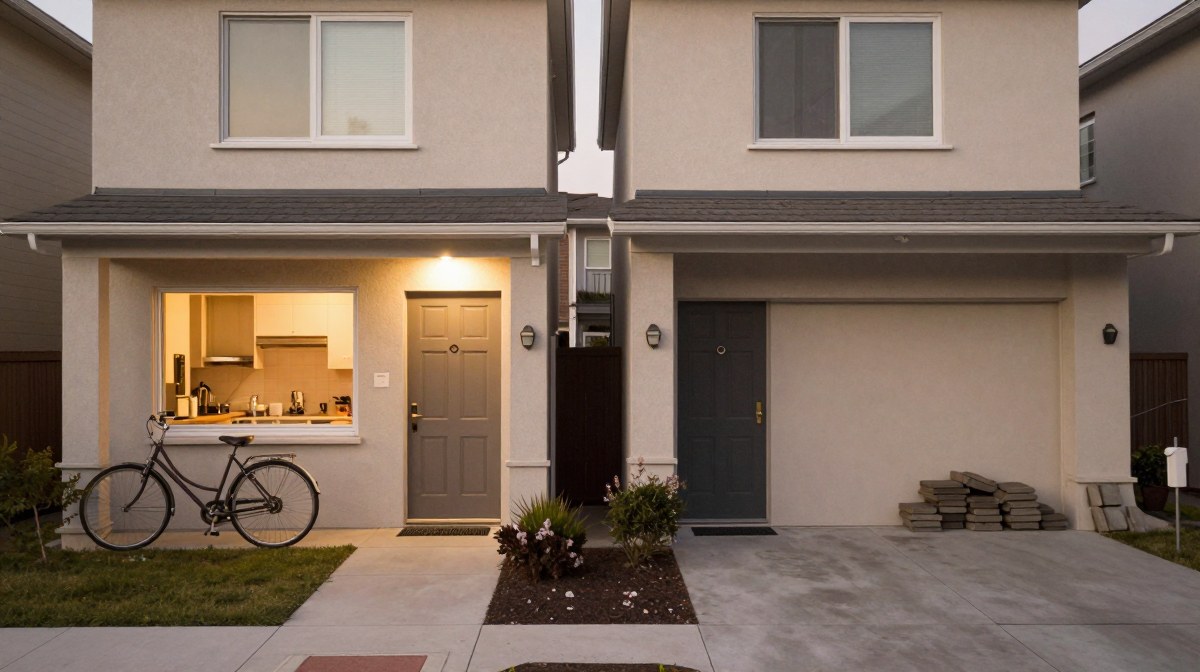
In short: Construction loans for duplexes and dual occupancy builds work like a house construction loan - staged draws, an as-if-complete valuation, interest on the drawn balance - but the lender also asks how you will use the two dwellings, what title they will sit on at completion, and how much rent it can count. Keeping both, or living in one and renting the other, is usually funded as a construction loan; building both to sell is treated as a development.
Key takeaways
- A duplex you will keep, or live in one and rent the other, is usually a construction loan; building both to sell is usually development finance.
- Torrens or strata subdivision at completion lets each dwelling be valued, sold or refinanced on its own title.
- Until a subdivision registers, many lenders value and secure the property as one title.
- Lenders count only part of the expected rent, often around 80% (indicative), when testing serviceability.
- In the worked example, counted rent from both dwellings covers about 44% of the assessed repayment; from one dwelling, about 22%.
- Selling one dwelling can raise GST and income tax questions, so get advice before you plan the sale.
How is a duplex construction loan different from a house construction loan?
The mechanics are the same. The lender values the finished property, releases funds in stages against a building contract, inspects before each draw and charges interest on the drawn balance. What changes is the risk being assessed. Two dwellings on one block mean a bigger contract, a more complex planning approval, and an end product whose value depends on how it is titled and used.
Lenders want answers to four questions before they size the loan:
- Use: will you keep both dwellings, live in one and rent the other, or sell one or both?
- Title: will the dwellings stay on one title or be subdivided, and when?
- Value: what is each dwelling worth on completion, and what is the whole worth if it cannot be split?
- Income: how much rent will the property produce, and how much of it can be counted?
Your answers set the loan type, the pricing, the valuation basis and the serviceability test, so settle them before you ask any lender for a figure.
Live in one, rent the other, or keep both?
| Plan | How lenders usually treat it | Income counted in serviceability | Tax and land tax notes (general) |
|---|---|---|---|
| Live in one, rent the other | Part owner-occupied, part investment; often split into two loan portions | Rent from one dwelling, shaded | Interest on the rented part may be deductible; land tax on the rented part depends on your state |
| Keep both and rent | Investment construction loan | Rent from both dwellings, shaded | Investment pricing; land tax likely above your state's threshold |
| Sell one, keep one | Construction loan with the sale as the exit for part of the debt | Rent or occupancy of the kept dwelling | GST and income tax on the sale may apply |
| Sell both | Usually development finance | Sale proceeds, not rent | GST on new residential premises; profit likely taxed as income |
Owner-occupied and investment portions are often priced differently; our guide to owner-occupier vs investor pricing explains why. Splitting the loan into a portion for each dwelling makes it easier to track interest that may be deductible, and to sell or refinance one dwelling later without restructuring everything.
Land tax is a state tax, and states treat a partly rented property differently. Victoria's State Revenue Office describes land tax as an annual tax on the total value of taxable land you own in Victoria, with exempt properties such as your home excluded, and Revenue NSW sets out its own land tax rules and exemptions. Check your state's position on the rented dwelling before you budget.
Strata or Torrens title: does it change the loan?
A dual occupancy can stay on one title, or be subdivided at completion into two Torrens titles (each dwelling on its own land) or a small strata scheme (each dwelling a lot, with common property and an owners corporation). What your council allows depends on zoning and lot size, and subdivision usually needs its own subdivision approval and a surveyor.
| Title at completion | What the lender holds | Effect on the loan |
|---|---|---|
| One title, no subdivision | One property with two dwellings | One valuation; some lenders treat it like a house with a second dwelling and value it more conservatively |
| Two Torrens titles | Two separate properties | Each valued and secured on its own; simpler to sell or refinance one |
| Two-lot strata scheme | Two lots plus common property | Each lot valued separately; the lender checks the strata plan and by-laws |
Timing matters. During construction the lender holds one title. If the subdivision registers after completion, the lender may value and secure the property as one title until then, and you will need its consent and a partial discharge to release one dwelling for sale. Budget the subdivision costs - survey, council and authority fees, separate service connections and meters - inside the project, not after it.
How are the two dwellings valued?
The valuer usually reports an as-if-complete value for each dwelling on the title basis that will exist at completion, plus a value for the whole. The parts and the whole do not always line up. Two separately titled dwellings can be worth more together than one title with two dwellings on it, because each can be sold to an owner-occupier on its own; on one title, the buyer pool is mostly investors and families wanting two homes on one block.
Comparable sales matter more than for a single house. The valuer looks for sales of similar new duplex halves or dual occupancies nearby, and where there are few, valuations are more cautious. Features the local market does not pay for - a third living area, a pool on each side - add cost without equal value, the same over-capitalisation risk as any build.
Rent is assessed too. For any dwelling you will lease, the valuer usually provides a rental assessment, and that is the figure the lender starts from in serviceability, not your own estimate or an agent's appraisal.
Worked example: sizing the loan and counting the rent
For illustration only - example figures, not any lender's policy or an offer. You own a block valued at $800,000 with a $300,000 loan on it. A fixed-price contract for two dwellings is $1,100,000. The valuer reports $2,000,000 on one title, or $1,050,000 and $1,000,000 ($2,050,000) as two Torrens titles, with rent of $750 a week for each dwelling.
| Line | Amount |
|---|---|
| Funding needed ($300,000 land loan plus $1,100,000 contract) | $1,400,000 |
| LVR on $2,000,000 as one title | 70% |
| Assessed repayment: an example 6.6% rate plus a 3 point buffer, 9.6% P&I over 30 years | About $11,874 a month |
| Gross rent, both dwellings ($750 × 52 × 2) | $78,000 a year |
| Rent counted at 80% (indicative shading) | $62,400 a year, or $5,200 a month |
| Share of the assessed repayment covered if you keep both | About 44% |
| Rent counted from one dwelling at 80% | $31,200 a year, or $2,600 a month |
| Share covered if you live in one | About 22% |
The rest must come from your other income after living expenses and other debts. The buffer is APRA's: banks assess at least 3 percentage points above the loan rate, a setting APRA kept on 28 May 2026. Rent is shaded for vacancies, agent fees and upkeep, which our guide to gross vs net rental yield breaks down.
If instead you sell the second dwelling at completion for $1,000,000, with example selling costs of 2.5% ($25,000), the $975,000 net would cut the debt to $425,000 against the $1,050,000 dwelling you keep, an LVR of about 40% - before any GST or income tax on the sale, which could change the figures materially.
When does a duplex build become development finance?
When the plan is to sell, not to hold. A lender funding two dwellings to sell is lending against the sale proceeds, so it assesses the project as development finance: total cost and gross realisation value, sales evidence, a quantity surveyor's cost plan, often capitalised interest, and an exit that depends on buyers rather than your salary.
| Feature | Construction loan (hold) | Project funding to sell |
|---|---|---|
| Repaid from | Your income and rent, over the loan term | Sale proceeds at completion |
| Sized on | As-if-complete value (LVR) | Total cost and gross realisation value |
| Serviceability | Full personal assessment | Project feasibility and exit |
| Interest | Usually paid monthly | Often capitalised |
| Tax on a sale | Usually not at issue | GST and income tax likely |
Tax follows the purpose. Selling new residential premises can be a taxable supply under the A New Tax System (Goods and Services Tax) Act 1999, and the ATO's guidance on building and construction of residential premises explains when. Selling one dwelling of a pair can raise the same questions. This is general information, not tax advice: get your accountant's view before you sign the building contract, because it can change how you structure the loan and the ownership. Our guide to construction and development finance compares the two paths.
What extra documents do lenders want for a duplex?
- The planning or development approval for two dwellings, with its conditions, and any subdivision approval.
- Plans and specifications for both dwellings, with the inclusions for each.
- A fixed-price contract that prices both dwellings and the shared works: driveway, fencing, services.
- The builder's licence, its experience with multi-dwelling work, and home warranty cover for both dwellings.
- Rental assessments for any dwelling you will lease.
- Your plan for title at completion and the subdivision timeline.
- If you plan to sell one, your accountant's advice on GST and income tax.
Use the construction progress draw calculator to see the interest on the larger draws of a two-dwelling contract.
What should you do next?
Decide the end state first: keep both, live in one and rent the other, sell one, or sell both. That single choice decides the type of loan, how the property will be titled and how the lender will count your income. When it is clear, post one construction loan request on ADS and 200+ verified lenders and brokers can ask about it. Speak to your accountant and a licensed adviser before you commit.
Frequently asked questions
Can I get a construction loan for a duplex?
Yes, if you plan to keep both dwellings or live in one and rent the other. Lenders want the planning approval for two dwellings, a fixed-price contract covering both, a valuation of each dwelling and rental assessments. If you plan to sell both, lenders usually treat it as development finance instead.
Do lenders count rent from a duplex that is not built yet?
Usually yes, based on the valuer's rental assessment, but only part of it - often around 80% of gross rent (indicative, it varies by lender) - to allow for vacancies and costs. Only a dwelling you will actually lease counts; the one you live in produces no rent.
Should a duplex be subdivided into Torrens or strata titles?
It depends on what your council allows and what you plan to do. Torrens titles give each dwelling its own land and no owners corporation, which can make each simpler to sell or refinance. A two-lot strata scheme shares common property and has by-laws. The lender values and secures whichever title exists at completion.
Can I sell one half of a duplex and keep the other?
Usually, once the dwellings are on separate titles and the lender agrees to release the one you sell, with the proceeds normally reducing the loan. Selling a new dwelling you built can raise GST and income tax questions, so get tax advice before you plan the sale.
Will a duplex build be priced as owner-occupied or investment?
If you live in one and rent the other, many lenders split the loan into an owner-occupied portion and an investment portion, each priced on its own. If you rent both, the loan is generally investment. The split also helps your accountant work out which interest may be deductible.
Related reading
- Owner-Occupier vs Investor Pricing
- Rental Yield: Gross vs Net Calculation
- Construction and Development Finance
Sources
- Land tax in Victoria — State Revenue Office Victoria
- Land tax in NSW — Revenue NSW
- APRA maintains macroprudential settings: 3 percentage point serviceability buffer (28 May 2026) — Australian Prudential Regulation Authority
- A New Tax System (Goods and Services Tax) Act 1999 — Federal Register of Legislation
- Building and construction: residential premises (GST) — Australian Taxation Office
Information current as at 24 October 2026.
General advice warning: This article contains general information only. It does not take into account your objectives, financial situation or needs, and it is not personal credit or financial advice. Consider whether it is appropriate for you and seek advice from a licensed credit representative before acting.
Any interest rate shown is an example only and is not an offer of credit. Where a rate is quoted, the applicable comparison rate is available from the relevant lender and should be considered alongside it.
Tags
Related Posts

Business Loans to Fund Growth: Hiring, Stock and a Second Site
Fund growth with business loans matched to what each dollar buys: a term loan for a fit-out, equipment finance for machines, a revolving facility for stock and wages, and owners' money or equity fo...

Working Capital Loans: Sizing a Facility to Your Cash Conversion Cycle
Size a working capital loan from your cash conversion cycle, not from a round number. Add debtor days and inventory days, subtract creditor days, and multiply the result by your daily cost of sales...
Land Subdivision Finance: Funding Lots From Approval to New Titles
Land subdivision finance funds the period between subdivision approval and the issue of new titles: buying or refinancing the englobo land, paying for civil works and council contributions, and car...