
Buying a Development Site Before Approval: Land Acquisition Finance and DA Risk
ADS Team
Author
November 17, 2026
about 2 hours ago
2
views
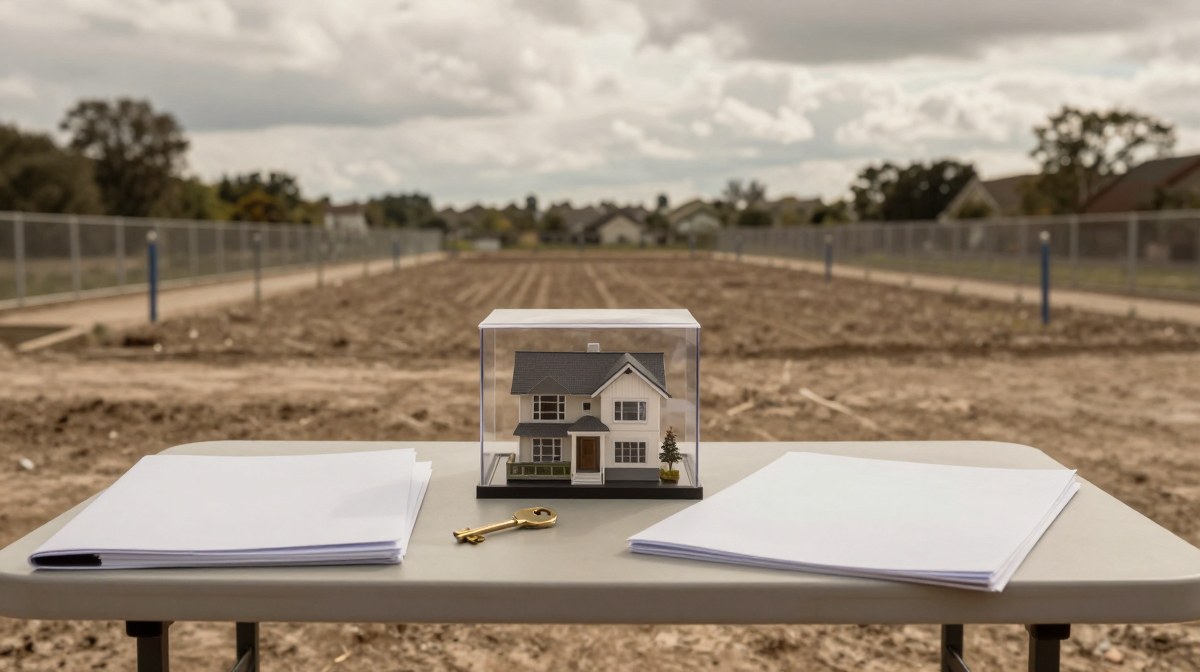
In short: Land acquisition finance for a site without a development approval (DA) is lent on the land's value as it stands, not on what it could become. Expect lower LVRs, interest that is often capitalised, higher pricing and a short term, because the lender's exit depends on a planning decision nobody controls. Options and conditional contracts can shift the DA risk off your balance sheet, and every lender will ask what happens if the DA is refused.
Key takeaways
- Before a DA, lenders value the site "as is", often as an ordinary property, so the development upside does not support the loan.
- In the worked example, a 65% LVR facility with 15 months of capitalised interest advances only about 56% of the price at settlement.
- Banks usually want income to service a land loan; private lenders lend on the asset and the exit, at a higher price (indicative).
- A call option or a contract conditional on the DA can cap your loss at the option fee and DA costs if consent is refused.
- In the example, buying outright and losing the DA costs about $1 million; the option route caps the loss at $350,000.
- The exit plan must work in three cases: DA granted and you build, DA granted and you sell, DA refused.
Why is a site without a DA harder to fund?
A development site's price often reflects what the buyer expects council to allow. Until consent is granted, that is a forecast. The lender's valuer will usually value the site "as is": an older house on a large block, a vacant parcel under its current zoning, or a commercial building with its existing tenants. Any premium you paid for potential is, to the lender, unsupported.
The lender's second concern is the exit. A land loan is short-term debt that has to be repaid by a development facility, a sale or a refinance. Each of those depends on the DA outcome and timing, which neither you nor the lender controls. So the lender lends less, charges more, and wants to see several ways out.
Most loans to a company or trust to buy a development site are business-purpose credit. The consumer protections in the National Consumer Credit Protection Act and its National Credit Code generally do not reach credit used wholly or mainly for business purposes, so the contract terms matter more. If you borrow in your own name, ask your lawyer which regime applies; what a business purpose declaration is explains the document lenders ask you to sign.
How much will a lender advance on an unapproved site?
Leverage is lower than for a site with consent, and it depends heavily on the lender and on whether the property earns income (indicative):
| Lender type | Typical approach to a site without a DA (indicative) |
|---|---|
| Banks | Lend on the "as is" value, often at conservative LVRs, and usually want the interest serviced from rent or your other income |
| Non-bank lenders | Similar LVRs or slightly higher; may capitalise interest for a set period |
| Private lenders | Lend on the asset and exit, commonly with capitalised or prepaid interest, at higher rates and fees, for 6 to 24 months |
The headline LVR overstates the cash you receive when interest is capitalised, because the interest allowance is part of the limit. For illustration: a $2,400,000 site, a private lender at 65% of a $2,400,000 valuation (a $1,560,000 limit), a 2% establishment fee ($31,200), and 15 months of interest at an illustrative 11% a year, compounding monthly and capitalised. These figures are examples, not an offer.
| Line | Amount |
|---|---|
| Facility limit (65% x $2,400,000) | $1,560,000 |
| Less establishment fee | -$31,200 |
| Less interest reserve for 15 months | -$195,563 |
| Net advance at settlement | $1,333,237 (55.6% of the price) |
| Price plus illustrative duty ($130,000) and legal costs ($10,000) | $2,540,000 |
| Your equity at settlement | $1,206,763 |
The interest reserve is the net advance multiplied by (1 + 0.11 / 12) to the power of 15, less the net advance. Duty is a real and state-specific cost; check your state revenue office, such as Revenue NSW's transfer duty page, which also covers options and off-the-plan purchases. The DA itself (architect, planner, engineers, traffic, heritage and environmental reports) is usually funded from your equity as well.
How do options and conditional contracts reduce DA risk?
DA risk often costs less to carry if you do not own the site while you take it.
| Structure | How it works | Your risk if the DA is refused |
|---|---|---|
| Call option | You pay the owner an option fee for the right, not the obligation, to buy at an agreed price within a set period, while you lodge the DA | The option fee and your DA costs |
| Put and call option | Both parties can trigger the sale; often used to lock in a purchase while deferring settlement | Depends on the terms; may oblige you to buy |
| Contract conditional on the DA | A standard contract that ends, or can be ended, if consent is not granted by a date, often with a long settlement | Usually your DA costs and any non-refundable deposit |
| Outright purchase | You buy and settle, then lodge the DA | The fall in the site's value, plus holding costs, duty and DA costs |
Vendors usually charge for flexibility, through a higher price, a non-refundable option fee or a long settlement at a fixed price, and many will not agree at all in a strong market. Options can also have duty and tax consequences, and whether an option or nomination is treated as a dutiable transaction depends on state law. Get legal and tax advice before you sign.
What does a refused DA cost? Two paths compared
Continue the example. You spend $250,000 on the DA over 15 months. Council refuses consent, and the site is now valued as a house on a large block at $2,000,000. For simplicity, the existing house earns $700 a week in rent ($45,500 over 15 months, before costs) and the site sells for $2,000,000 less 2% selling costs.
| Outright purchase | Amount |
|---|---|
| Price, duty and legal costs | $2,540,000 |
| DA costs | $250,000 |
| Capitalised interest and establishment fee | $226,763 |
| Total outlay | $3,016,763 |
| Less sale proceeds after selling costs and rent received | -$2,005,500 |
| Loss | $1,011,263 |
Under a 12 to 15-month call option for an illustrative $100,000 fee, the same refusal costs the fee plus the $250,000 of DA costs: $350,000, with no debt to repay and no property to sell. The option is not costless when the DA succeeds, since the vendor may have demanded a higher price for it, but it changes a possible million-dollar loss into a capped one.
This is why lenders and experienced developers ask the same question first: "What is the worst case, and can you survive it?"
How do lenders price DA risk?
DA risk shows up in four places in a land loan offer:
- Leverage. A lower LVR on the "as is" value than the lender would apply once consent is granted.
- Price. A higher interest rate and larger establishment and line fees, especially from private lenders.
- Term. A short term, often tied to the expected DA date plus a buffer. If the DA runs late, you need an extension, usually with fees.
- Conditions. Interest reserves, a requirement to lodge the DA by a date, reporting on its progress, and sometimes additional security over another property.
Lenders read the planning context: current zoning, the planning controls, recent consents nearby, objections lodged, and whether the proposal sits comfortably inside the controls or depends on variations. A scheme that complies with the controls is easier to fund than one that relies on a height or density variation. Have your planner's report ready; it is evidence, not marketing. For a fuller picture of what higher-cost short-term money involves, see what private lending actually costs and Moneysmart's explainer on private credit, which notes that this market includes construction and development lending.
What are the exits, and which one will the lender believe?
A land loan needs an exit that works whatever the planning outcome:
- DA granted, you develop. The land loan is repaid by a development facility. Check in advance that your numbers support one: the feasibility study, the equity you will need, and whether the development lender will recognise the land's value with consent as part of your equity.
- DA granted, you sell the site. A site with consent can be worth more than one without, though not always as much as hoped. A sale repays the loan and may return a profit.
- DA refused. You appeal to the planning court or tribunal in your state (for example the Land and Environment Court in NSW, VCAT in Victoria or the Planning and Environment Court in Queensland), redesign and lodge again, hold the property on its existing use, or sell. Each takes time and money, and the land loan's term may not cover it.
Lenders believe exits that are already partly in place: a development lender's indicative terms, a buyer's interest in the site with consent, or enough income to refinance the land on its existing use at a bank. Exit strategies for short-term loans covers how lenders test them.
What should you prepare before you ask for land acquisition finance?
- The contract or option, with the settlement date, conditions and any nomination rights.
- A planner's report on the controls, likely outcome and DA timeline.
- A concept design and a preliminary feasibility study; run it in the development feasibility calculator at both the expected and a lower density.
- Your budget for DA costs and holding costs, and where the equity comes from.
- Income evidence if you want a bank to lend on the site, and the existing lease if the property is rented.
- Your exit plan for all three outcomes, with numbers.
Lenders usually want a plan before they lend; business.gov.au's business loan guidance lists the financial documents to prepare. When the package is ready, post one development finance request on ADS and 200+ verified lenders and brokers can ask about it.
Frequently asked questions
Can I get a loan to buy land before a DA?
Yes, but expect it to be lent on the land's current value rather than its development potential. Banks may lend at conservative LVRs if you can service the loan from income or rent; private lenders lend on the asset and the exit, usually with capitalised interest and higher costs (indicative). Your equity also funds the DA costs.
What LVR can I get on an unapproved development site?
It varies widely by lender, location and the property's current use, and is generally lower than on a site with consent (indicative). Remember that capitalised interest sits inside the limit: in the illustrative example, a 65% LVR facility advances about 56% of the price at settlement.
What is a call option on a development site?
An agreement under which you pay the owner a fee for the right, but not the obligation, to buy the site at an agreed price within a set period. You use the period to lodge the DA. If consent is refused, you let the option lapse and lose the fee and your DA costs, but you do not have to buy.
What happens to my land loan if the DA is refused?
The loan still has to be repaid by its expiry date. Your choices are to appeal, redesign and lodge again, refinance on the property's existing use, or sell. If none can be done in time, you will need an extension from the lender, usually with fees, or face default terms. Plan this exit before you buy.
Is it better to buy a site with a DA already in place?
It is usually easier to fund and less risky, because the lender can rely on the consent. You generally pay more for the site, as the vendor has taken the planning risk and wants to be paid for it. Buying without a DA can be more profitable, but only if you can carry the loss if consent is refused.
Related reading
- Exit Strategies: How Short-Term Loans Get Repaid
- What Private Lending Actually Costs in Australia
- Construction and Development Finance
Sources
- National Consumer Credit Protection Act 2009 — Federal Register of Legislation
- Transfer duty — Revenue NSW
- What is private credit — Moneysmart (ASIC)
- Business loan guidance — business.gov.au
Information current as at 24 October 2026.
General advice warning: This article contains general information only. It does not take into account your objectives, financial situation or needs, and it is not personal credit or financial advice. Consider whether it is appropriate for you and seek advice from a licensed credit representative before acting.
Any interest rate shown is an example only and is not an offer of credit. Where a rate is quoted, the applicable comparison rate is available from the relevant lender and should be considered alongside it.
Related Posts
Construction Loans for Duplexes and Dual Occupancy Builds
Construction loans for duplexes and dual occupancy builds work like a house construction loan - staged draws, an as-if-complete valuation, interest on the drawn balance - but the lender also asks h...

Business Loans to Fund Growth: Hiring, Stock and a Second Site
Fund growth with business loans matched to what each dollar buys: a term loan for a fit-out, equipment finance for machines, a revolving facility for stock and wages, and owners' money or equity fo...

Working Capital Loans: Sizing a Facility to Your Cash Conversion Cycle
Size a working capital loan from your cash conversion cycle, not from a round number. Add debtor days and inventory days, subtract creditor days, and multiply the result by your daily cost of sales...