
What Happens to Your Construction Loan If the Builder Goes Insolvent
ADS Team
Author
November 9, 2026
about 14 hours ago
9
views
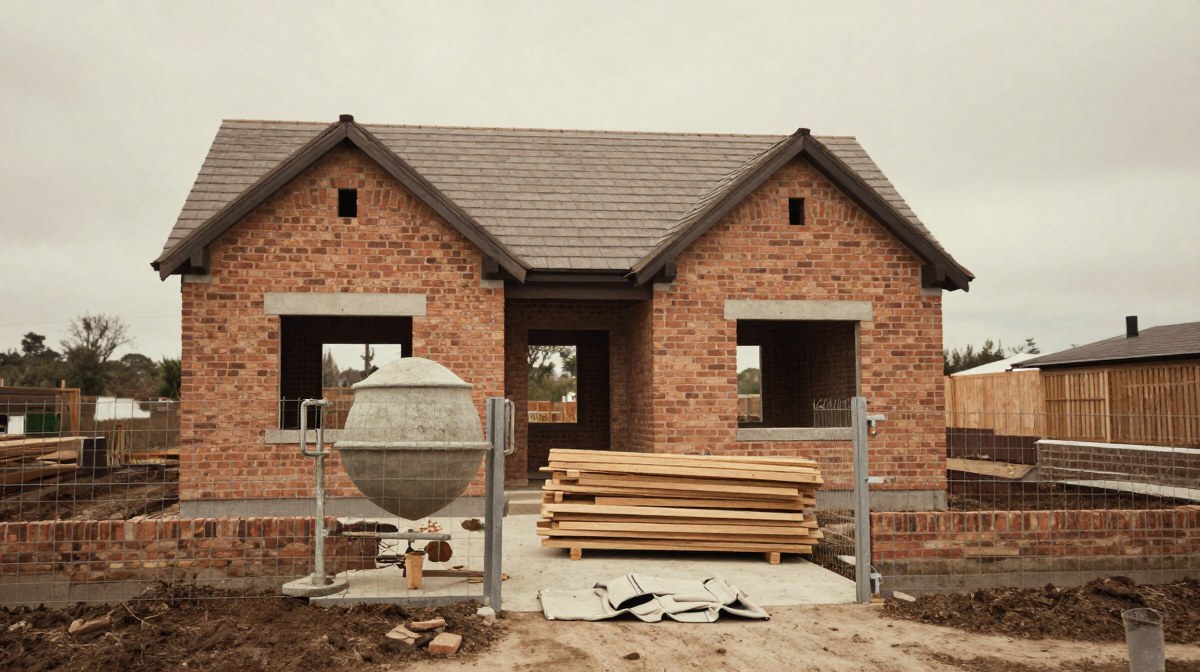
In short: If your builder goes insolvent, your construction loan does not end. Interest keeps running on what has been drawn, and the lender holds the undrawn funds until a replacement builder is signed and the cost to complete is checked again. In the liquidation you are usually an unsecured creditor, so recovery there is uncertain. Home warranty insurance, where it applies, is often the main backstop, and any gap between the undrawn balance and the new price is yours to fund.
Key takeaways
- The loan contract survives the builder: you keep paying interest on the drawn balance while work is stopped.
- Lenders freeze further draws until a new builder contract, valuation and cost-to-complete are in place.
- An owner with a deposit or overpayment is usually an unsecured creditor, paid only after costs and employees.
- Home warranty or domestic building insurance generally covers non-completion when a builder is insolvent, within caps and time limits that vary by state.
- Replacement builders price in risk and today's costs, so the new price is usually higher than what is left on the old contract.
- Lodge claims early, keep every document, and talk to the lender before you sign anything new.
What happens first when a builder becomes insolvent?
Work stops. An external administrator is appointed: a liquidator, a voluntary administrator, or a receiver appointed by a secured lender to the builder. The administrator takes control of the company, which can mean the site is locked and trades stop turning up. Your building contract is not automatically ended; what happens to it depends on its terms and the administrator's decisions, so get legal advice before you terminate anything.
Check what has happened on ASIC's registers, whose published notices include insolvency and external administration notices. ASIC's insolvency guidance for creditors has separate guides for liquidation, receivership, voluntary administration and deeds of company arrangement, because your options differ under each.
In the first week:
- Secure the site and the insurance. The builder's contract works cover may lapse, so arrange your own cover for the partly built house.
- Tell your lender in writing. Ask what it needs before any further draw.
- Notify the home warranty insurer if your build had a policy. Claim windows can be short.
- Record the work in place with dated photos, the last progress claim, invoices and correspondence.
- Stop paying claims until you have advice on what is owed and to whom.
Where do you stand as a creditor in the liquidation?
If the builder goes into liquidation, ASIC's Liquidation: a guide for creditors (INFO 45) sets out the process. The liquidator is independent and has a duty to all creditors. To be paid a dividend you must prove your debt when the liquidator calls for proofs, attaching invoices and other supporting documents. The liquidator must send creditors a statutory report within three months of appointment, covering the likely dividend and possible recoveries.
The order of payment is what matters to an owner. Under INFO 45, funds generally go in this order, and each category must be paid in full before the next receives anything:
| Order | Who is paid | What it means for you |
|---|---|---|
| 1 | Costs of the liquidation and the liquidator's fees | Paid before any creditor |
| 2 | Unpaid employee wages and superannuation | Priority over you |
| 3 | Unpaid leave | Priority over you |
| 4 | Employee retrenchment pay | Priority over you |
| 5 | Unsecured creditors, including most owners, subcontractors and suppliers | Shared pro rata from whatever is left |
A secured creditor with a security interest over the builder's assets ranks ahead of all this for those assets. An owner who paid a deposit or a claim for work not yet done is usually an unsecured creditor, and the dividend, if any, can take a long time and is often a fraction of the debt. Plan the rest of the build as if nothing comes back.
What does your lender do with the undrawn funds?
Nothing, until it is satisfied the house can still be finished. The undrawn part of the construction loan stays undrawn, and interest continues on the drawn balance. Most construction loan contracts let the lender stop draws when the builder defaults or the cost to complete is in doubt, and lenders use that right.
To restart, expect the lender to ask for:
| Item | Why the lender needs it |
|---|---|
| A signed contract with a licensed replacement builder | Defines the work left and its price |
| A new valuation of the work in place and the as-if-complete value | Confirms the security still supports the loan |
| A cost-to-complete report (a quantity surveyor on larger jobs) | Tests whether the undrawn funds cover the new price |
| Status of the insurance claim | Shows what the insurer will contribute and when |
| Evidence of your funds for any gap | Lender's money goes in only once the gap is covered |
| A revised timeline | The construction period in the loan may need extending |
The lender's progress inspections are some protection here. Because each draw was released only after a valuer confirmed the stage, the money drawn should broadly match the work in place. The problem is usually what was paid outside the loan, such as a large deposit or a claim paid early.
How does home warranty insurance help?
In most states and territories, residential building work above a set value needs home warranty cover arranged by the builder before work starts, with a certificate for you. The name varies by state (home warranty, domestic building insurance, home building compensation, home indemnity), and so do the thresholds, caps and claim periods, so check your state's scheme rather than relying on any figure you have heard.
In general terms most of these schemes are a last resort: they respond when the builder has died, disappeared or become insolvent. They typically cover:
- the extra cost of completing the work above the original contract price, up to a cap;
- defects in the work, within time limits that differ for major and minor defects;
- in some schemes, loss of a deposit.
They do not usually cover everything. Commercial work and many multi-storey residential buildings fall outside them, payouts are capped, and claims must be lodged within set periods. Owner-builders sit under separate rules: Western Australia, for example, requires home indemnity insurance when an owner-builder sells within seven years, under its owner-builder permit rules.
Lenders normally ask for the warranty certificate before the first draw for exactly this reason. If you have not seen yours, find it now.
Worked example: how big is the funding gap?
For illustration only - example figures, not any lender's policy or an insurer's assessment. Your loan limit is $1,050,000: a $350,000 land loan plus a $700,000 fixed-price contract. The as-if-complete value was $1,400,000, a 75% LVR. The builder fails after the frame stage, with the deposit (5%), base (15%) and frame (20%) paid: $280,000.
| Line | Amount |
|---|---|
| Drawn: land loan plus 40% of the contract | $630,000 |
| Undrawn build funds ($1,050,000 less $630,000) | $420,000 |
| Replacement builder's price to finish | $560,000 |
| Gap before insurance | $140,000 |
| Insurance contribution (example) | $60,000 |
| Gap after insurance | $80,000 |
| Interest while work is stopped: 4 months on $630,000 at an example 7.0% | $14,700 |
| Cash needed, before rent | $94,700 |
Why is the new price higher than the $420,000 left on the old contract? A replacement builder takes on work it did not start, must check and sometimes fix it, has to remobilise trades, and prices at today's costs. The ABS Producer Price Indexes show house construction output prices up 5.9% in the twelve months to the June quarter 2026. Builders are also busy: the ABS counted 248,733 dwellings under construction in the June quarter 2026 in its Building Activity release.
The interest line is $630,000 × 0.07 ÷ 12 = $3,675 a month, times four months. Model your own stop with the construction progress draw calculator.
How is the funding gap closed?
| Option | What it involves | Watch for |
|---|---|---|
| Your cash or savings | Paid in before the lender's next draw | Keep a reserve for the rest of the build |
| Increase the construction loan | New valuation and a full credit reassessment | The higher limit must pass serviceability and LVR |
| Equity in another property | A top-up on that property's loan | A second assessment and valuation |
| A second facility from another lender | Usually higher cost; the first lender must consent | Exit plan at completion |
| Insurance claim | Pays some or all of the extra completion cost, up to a cap | Timing; the insurer may want its own builder |
| Reduce scope | Defer landscaping, driveways, some finishes | The valuer may lower the as-if-complete value |
| Proof of debt in the liquidation | Lodged with the liquidator | Slow and uncertain; never the plan |
In the example, raising the limit by $80,000 to $1,130,000 against the same $1,400,000 value lifts the LVR from 75% to about 80.7%, which may push the loan into a different pricing tier or past the lender's limit. Our guide to LVR and equity calculations shows how to run those numbers.
On commercial builds, the contract often gives the owner security from the builder, such as cash retentions or a bank guarantee, which can be called on default. Residential contracts rarely do.
What does the lender re-check before funding again?
Treat the restart as a new credit decision on an existing loan. The lender re-values the work in place and the finished house; defects found by the new builder, or a softer market, can lower both. It re-tests serviceability on any higher limit, and banks assess repayments at least 3 percentage points above the loan rate, the buffer APRA kept on 28 May 2026. And it checks the replacement builder the same way it checked the first one.
If the repayments are the problem rather than the gap, say so early. Lenders have hardship and variation processes, and our explainer on financial hardship and your rights covers what you can ask for before you miss a payment.
How do you protect yourself before you sign with a builder?
- Search the builder's company on ASIC's registers and its ABN, and check the licence with your state regulator.
- See the home warranty certificate before you pay a deposit, and check it names your address.
- Keep the deposit at the level your state allows and never pay ahead of a stage.
- Pay every claim through the lender's draw process, so a valuer confirms the work first.
- Watch for warning signs: unexplained delays, requests for early payment, subcontractors saying they have not been paid.
- Keep a contingency you could use to cover a gap like the one above.
Read how construction loan progress payments work to see why paying only against verified stages protects you. When you are ready to fund a build or a restart, post one construction loan request on ADS and 200+ verified lenders and brokers can ask about it. This is general information, not legal advice; a building or insolvency lawyer should review your position.
Frequently asked questions
Does my construction loan end if my builder goes into liquidation?
No. The loan is between you and the lender, so it continues. You keep paying interest on the drawn balance, and the lender holds the undrawn funds until a replacement builder contract, new valuation and cost-to-complete are in place. The construction period in the loan may need extending.
Will I get my deposit back if my builder goes broke?
Possibly part of it. Some home warranty schemes cover a lost deposit within limits. Otherwise you are usually an unsecured creditor in the liquidation, paid only after the liquidator's costs and employee entitlements, and often only a fraction of the debt. Lodge a proof of debt with supporting documents when the liquidator calls for them.
Who finishes the house if the builder is insolvent?
Usually a replacement builder you engage under a new contract, or one arranged through the home warranty insurer if the claim responds. Liquidators rarely complete residential jobs. Your lender must accept the new builder and contract before it releases further draws.
Does home warranty insurance cover builder insolvency?
Generally yes, for residential work that required a policy and had one issued. In most states it is last-resort cover for non-completion and defects when the builder has died, disappeared or become insolvent, with caps and claim periods that vary by state. Commercial work and many multi-storey buildings are outside it.
How can I check whether a builder is in financial trouble?
Search the company and its published notices on ASIC's registers, check the ABN on ABN Lookup and the licence with your state regulator. On site, watch for long unexplained delays, requests to pay ahead of a stage, and subcontractors or suppliers chasing unpaid invoices.
Related reading
- Construction Loans: How Progress Payments Work
- Financial Hardship: Your Rights Before You Miss a Payment
- LVR and Equity: Worked Calculations
Sources
- Liquidation: a guide for creditors (INFO 45) — Australian Securities and Investments Commission
- Insolvency guidance for creditors — Australian Securities and Investments Commission
- Search ASIC registers, including published insolvency notices — Australian Securities and Investments Commission
- Owner-builder permit requirements, Western Australia (updated 16 September 2026) — Government of Western Australia
- Producer Price Indexes, Australia, June quarter 2026 (house construction output prices) — Australian Bureau of Statistics
- Building Activity, Australia, June quarter 2026 (dwellings under construction) — Australian Bureau of Statistics
- APRA maintains macroprudential settings: 3 percentage point serviceability buffer (28 May 2026) — Australian Prudential Regulation Authority
Information current as at 24 October 2026.
General advice warning: This article contains general information only. It does not take into account your objectives, financial situation or needs, and it is not personal credit or financial advice. Consider whether it is appropriate for you and seek advice from a licensed credit representative before acting.
Any interest rate shown is an example only and is not an offer of credit. Where a rate is quoted, the applicable comparison rate is available from the relevant lender and should be considered alongside it.
Tags
Related Posts

Pre-Sales in Development Finance: How Many You Need and Why Lenders Ask
Lenders offering development finance ask for pre-sales because each unconditional, arm's-length contract with a proper deposit is evidence that the debt will be repaid. The requirement is usually e...

Earn-Outs in Business Acquisition Finance: How Lenders Treat Deferred Payments
An earn-out in business acquisition finance is part of the price that is paid only if the business hits agreed targets after settlement. It cuts what you borrow upfront, because the lender funds a...

Commercial Loans for Retail Shops and Strata Offices: Small-Lot Lender Appetite
Lenders fund small shops and strata offices, but they treat them more cautiously than larger buildings. Commercial loans on small lots usually come with lower LVRs, closer attention to the tenant a...